Tuesday, October 4, 2011

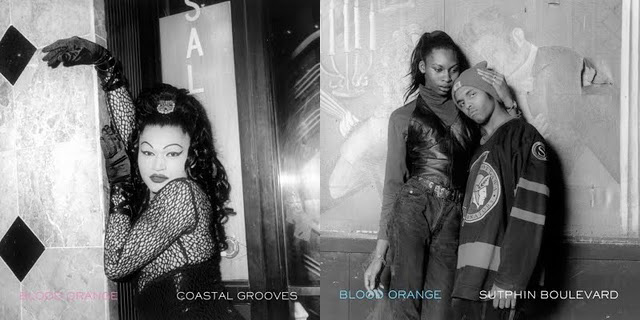
Coastal Grooves (Blood Orange) (2011)

Club Imitation


‘maybe she’s just pieces of me/ you’ve never seen…’ (Tori Amos, ‘Tear in Your Hand’)

When last we left him, Devonte Hynes was busy releasing a sophomore album for his more famous moniker, Lightspeed Champion (Life is Sweet, Nice to Meet You, 2010). In my review, I noted Hynes’ relentlessness as well as his innate genius of mixing pop and rock vis-à-vis his slavish love of pure forms keeping him in one skin too often. The talented twenty-five year old hails from Britain but has been so formalized in the mid West that you’d be excused for mistaking him as American. His debut album (Falling off the Lavender Bridge) was a solid introduction to his aesthetic, which is quickly catching on: he’s been writing a lot recently for Solange Knowles (Beyonce’s sister) and Florence and The Machine.

A year later and he has reinvented into something totally new. So new and mysterious that I’m not sure how to describe Blood Orange other than to say that Hynes has finally gotten that complimentary swagger he desperately needed. Or, maybe just gotten in touch with his depressed, feminine side. Like all compulsive-driven musicians, he’s tossing off ideas that others can only dream of inventing. Coastal Grooves is interestingly configured because its evidence of his own growth as an artist receptive to openness.

The immediacy of the guitar work coalescing with electronic beats on the opener, Forget It shows that Hynes has been hard at work. It’s a simple song, most notable for one line (‘I am not your savior baby girl’) sung many times over but its sheer minimalism is pleasing. Instantly Blank inserts gorgeous aside vocals that nearly steal the show. Hynes has stated that his reference for the album were basically drag queens of the very distant past and the cover shot for the album is indicative of this. He has stated also though that it was not meant to be a personal perspective from him on the issue that would arise and that’s where he runs into a few problems. All art is viewed through specific lenses and the author cannot extract himself from the written or sung word so Coastal Grooves is a definite balancing act.

Things are most balanced when Hynes rips away the self-efficacious masks his characters wear: the bluesy solution fronting Champagne Coast, the stark propulsion facing the doomed girl in Can We Go Inside Now? Or when he’s channeling transgender influences in an attempt to tie sound and sexuality together. A sense of sadness perforates the album as well but this can be tricky and he either hits or misses with the ten tracks, depending on the mood that’s set. It doesn’t help that his dissection of pop as Blood Orange doesn’t loosen up the techno and dance beats as expected. He instead uses a lot of dubs and minimalism, which work to an extent but doesn’t provide transcendence. Nor is there much wry humor either—something he’s provided in spades as Lightspeed Champion. More results like Madame Van Damme and Galaxy of the Lost would’ve done this project a hell of a lot good.

Coastal Grooves doesn’t exactly push through its intended denizens or reveal the hidden: Hynes tries hard to replicate the queer night-life but ends up with something that sounds more like the cool, straight guy’s perspective instead. The overlapping jazzy texture that dominates the record is his stamp but there’s little connection to the source material in its actualized form. Coastal Grooves is a highly romanticized look at multi-dimensional personalities to be sure but it’s just not them telling these tales. It’s fascinating in parts but that’s because Hynes is the type of nerdy genius that enthralls…which leads to another issue. You’ll listen to this project and end up forgetting everything else except his silky voice and solid grooves. The artistry involved though is too medicinal because he’s taken the excitable and loquacious and simply cleansed them with sterile normality. It’s a little lost on him that people go to clubs to enjoy a bit of escapism…to become something temporarily that they cannot be during the day. To experience the excitement of strangers, to flirt unashamedly or to merely unwind with the besties and bitch about work.

Yes, Hynes does well to accompany his subjects into their world but he’s nailed them to a wall of intense scrutiny without as much as any of the aforementioned joys or even a Cosmopolitan to sip on while waiting for last call. This wide-eyed Q&A wearies after a while because, seriously, who wants to focus on their problems while their having fun? Hynes seems to think otherwise and I’m guessing from now on they’ll only have him tag along because he’s the designated driver.

RATING: 7.5/10

Wednesday, August 17, 2011

POP CULTURE WATCH: ON TOLERANCE & SOCIAL, MEDIA RESPONSIBILITY.


A few months ago, I was privy to view a public service advertisement (PSA) dealing with tolerance of homosexuality before it was to be broadcast locally. After it was played, I noted to the other persons in the room that it was indeed bold, especially the personalities involved in it. It has since aired in the media, without much fanfare or controversy and I had all but forgotten about it.

That was until however this recent brouhaha over another PSA, featuring a former beauty queen and her brother. Christine and Matthew Straw are the only two persons in it and it barely lasts a minute but the deafening outbursts from the media and Church have come to derail it even before we can view it for ourselves.

A few things have disheartened me about this: first, the ad has not even been aired or viewed fully by all of the entities actively seeking to refuse it. Television Jamaica (TV-J) has disappointed no one by refusing to air it as its family-oriented position is well-known. However, the management structure of the RJR group (responsible for TV-J) has failed to look at the ever-changing direction of our culture. It has used the weak excuse of identifying its own brand with the PSA’s message and our buggery law as a staunch guide. When last I checked though, The Broadcasting Commission, not TV-J, dictated what was proper to be aired. Nor did I remember seeing a memo stating that the station was a registered religious institution. We watch TV-J for local entertainment and to learn. Indeed, RJR’s own website says it stands unwaveringly for, among other things, fairness and social responsibility. Thus, we can deduce that RJR is an anti-gay tolerance body as that was simply what the PSA was advocating against only. The PSA mentioned nothing about legalizing same-sex unions, (which is a whole different issue). If I’m wrong then I’d be happy to see its own message that is geared to promote tolerance in our society aimed at any minority groups. If no such PSA is forthcoming then I stand correct.

For, how can a media titan like RJR be accused of inaction in the age and rise of social media responsibility? We now know that the journalists working there are obligated therefore to uncover only happy, photo-cropped and biblically-pleasing images we wish the outside world to see. For, if we do not focus on something then it doesn’t exist, right? Homophobia is a part of our culture, there can be no denying that fact but is it the place of media in Jamaica to promote or hide that status quo or is it their responsibility to press our leaders into action as well as themselves?

My own interest in the PSA begun when I realized that I actually went to prep school with Matthew as well as the fact that the Church and the media were working overtime to get a forced reaction from the public for different reasons. The Church’s response to anything homosexual is the same stock reply. And as perversely homophobic as we are, newspapers know that any gay-themed headline sells papers like hot bread. Listening to the one progressive local media entity (Nationwide) and hearing the different church-folk decrying the PSA without even as much as watching/listening to it makes one wonder if they have any moral authority to, for example, criticize politicians, because their interest is limited and will never change. Indeed, what is the Church’s position on tolerance then? Where is their PSA? How would they frame an ad that sticks to their valid principles yet accept that such errant lives shouldn’t be killed? For that is what faces many gay people in Jamaica and you’d be a fool to think otherwise. Or, is it that the Church doesn’t see the need to be publicizing such an issue? No one asks the Church these questions but as an entity looking to dictate the morality of our lives, shouldn’t we expect more?

As for the media, I’m sure John Maxwell is turning in his grave at the display of silent cowardice. Homosexuality touches on every aspect of life (negatively and positively) so I’m sure there are gays in powerful positions in media, the Church and no doubt reading this article. They know that a few gay hustlers in New Kingston are not the only representation of that part of our society. Let’s not blindly forget that there are just as many heterosexual hustlers in the area too that are a nuisance. We can’t just dismiss their lives because Jesus would not have. We need to understand their misery and think that there may come a time when our own lives fall into such a state. Given the harsh economic crunch we’re in, for some of us that will be sooner rather than later.
If in rejecting the PSA both entities had put forth put feasible alternatives then there would be some choice. What they advocate though is delayed action or none at all and that approach lacks vision. No one I’ve spoken to since this story broke has even heard of this now infamous PSA but thanks to Youtube ,Twitter& Facebook, people can view and judge for themselves if its relevant.

The reception may stun the Church because it still feels as if it controls the way we think. I could incite hypocrisy on other topics like adultery (an even wider practiced biblical sin in Jamaica) but deep within every adult, lays a conscience and it guides you, with or without religious or State approval. What TV-J has done is to turn its back on its conscience and embrace instead the ideal of merely living a lie in hope no one pays too much attention. Like the popular #OnlyRealJamaicansKnow thread running on Twitter currently, this is the effect of the two-edged cutlass.

Bad Teacher (2011)


Man Eater


Within its first fifteen minutes, Bad Teacher springs a refreshing premise upon us—that of a sorta teacher romance story---then oddly just allows the pieces to unravel without much direction thereafter. There’s no denying Cameron Diaz (There’s Something about Mary, Gangs of New York) great moments but director Jake Kasdan’s (Zero Effect, Orange County) clumsy overreach is a constant sour point whenever things start to get clever. Even the film’s poster shows up this flaw: Elizabeth (Diaz) preciously slinking behind dark shades, with just the right levels of deliciousness, only for an ‘eat me’ post-it on a red apple defeating her cutesy purpose.

As the film begins, she thinks she’s done with teaching forever so she wears a stunning yellow dress on the last day, smiles broadly and speeds away in her car with a loud ‘adios, bitches’. It’s a memorable last line but sadly for her it comes back to sting immediately. She arrives home to find her fiancé and his mother waiting for her. It is a bad sign made worse with her forgetting that it’s his birthday. Thus caught out by a simple thing she offers to sign a pre-nuptial then informs them she’s pregnant. It’s a cheap, desperate ploy and she only gets cast out from the luxury she’d gotten used to as just reward. With no other choice around, Elizabeth returns to James Adams Middle School (J.A.M.S) to plot her next move.

That oddly enough means securing ten thousand dollars for a boob job. At first she tries to guilt her ex to pay for it then, in a terribly funny bit, asks her roommate. These moments of distress allow Diaz’s comedic talents to shine and when she learns that the teacher with the best overall student grade gets a bonus of nearly six thousand dollars, she goes into overdrive. Sadly, so too does the script written by Gene Stupnitsky and Lee Eisenberg. We get, at best, a mixed bag as Elizabeth’s twin aims become more convoluted and less funny.

Not that the film gives her a set-up fit for someone who appears ever the clever schemer: for starters, it took her a whole year to finally get the boyfriend to propose and it took an even bigger schemer (a male parent) to trip her unto an extra-lesson plan that could potentially bring in extra dough. Nor is she cynically practical. Most women would wait until they’ve secured the ring before quitting their day job but instead Elizabeth comes across as impetuous and rash…the antithesis of what she’s supposed to be. Diaz is the reason why it works any at all and the film pays very little detail to anybody else, which plays into stereotype with varying degrees of success and rancor. Thus we’re left with more questions than answers about Elizabeth. For example, how exactly did she end up in teaching when there are far more viable or quicker ways to climb up the social ladder?

Elizabeth is the typical American: using a job as a stepping-stone to something else. In this case, it isn’t a more rewarding job but to land a husband who’ll take care of her financially. Her cynicism towards the children is harsh but she’s well aware of the happy-fake level needed to operate within her realm. She even witnesses it among her own students and allows it to play out without much interference.

Kasdan however interferes too much; it’s not enough that Elizabeth has to deal with being alone but there’s a drinking and drug problem too. We never witness the beginning of her manipulative streak, thus the implication is that it’s an innateness that affects all women. Unlike the recent Bridesmaids though, Bad Teacher shoots through the smokescreen of love and feelings and gets right down to the more sinister issue of human property. For that’s how Elizabeth and her rival, Amy (Lucy Punch) view men here (through their battle for Scott, played boringly by Justin Timberlake).

Kasdan stumbles upon this darkness within both women then backs off in hope that slapstick magic will occur. It doesn’t because both are so steeped in their own game that you see the elimination of one of them long before it happens. What is less clear is how everyone else will pan out in their own miserable lives once the drama between the two divas finally concludes. The initial focus---that of the real plastic image women use as they make their way into the world of potential husbands—has been long lost since Elizabeth started to assess her own superficiality and attraction to, gasp, the penniless gym teacher, Russell (Jason Segel). He, at least, doesn’t mind the lack of silicone in her chest.

RATING: 6/10

4 (Beyonce) (2011)


The Good Grief


In the field of psycho-analysis, we’re told of the four varying levels of grief: denial, anger, bargaining and acceptance. One step may not strictly follow another in a certain order but in the maelstrom of emotions involved, all four cycles will be completed. One can argue as well that everyone is perpetually in one of these states but the process can only be fully appreciated after it is completed. That sense of completion comes through strongly on 4, the new album by Beyonce Knowles, former Destiny’s Child singer aka Mrs. Jay Z.

Hers is a career that has focused on huge achievements (Grammys, Billboard hits, ect) but none more culturally-relevant than that point in 2003 when she surpassed Jennifer Lopez as the ‘it’ girl of pop music with the release of her solo debut (Dangerously In Love). If that was the bargaining step of her career then it did not come without blows; many felt Knowles through her family involvement had ditched Destiny’s Child to selfishly pursue her own motives. The hits came but outside of Jay Z and NARAS (the Grammy organization) few felt an emotional connection to her. Then came B’day, her sophomore album that explored themes of backlash. It’s her anger meme but with some brilliant and wry tracks like Ring the Alarm and Irreplaceable. B’day did also start to see her tie concepts together with a little black humor---which, often times than not, makes for her best songs (Sugar Mama, Freakum Dress).

By the time I am…Sasha Fierce rolled around the playing field had shifted with the rise of ‘dark-side-of-the-force clones’ Rihanna and Lady Gaga. The album had a monster hit in Single Ladies (Put A Ring on It) but the pretentiousness involved only reinforced a sense of denial: she was no longer queen by might alone.

4 thus is her acceptance that she’s in a different space in her career now. Whereas her music before felt aggressively defending turf and ambition, here she mellows nicely in reflection. At first when I learned that she submitted seventy-two (72) tracks for the album, I felt it was more an egocentric ploy but hearing her cite Fela Kuti and Stevie Wonder as main influences made me realize that she was serious.

And there are great moments of raw emotion here: 1+1 showcases her vocals in its purest form, without any stylistic tricks or heavy padding. It’s the type of song one imagines she warm ups to in front of the mirror before going onstage to belt out the real gems, but here it ends up being a solid highlight. The piped in guitars and atmospherics chime in at just the right levels and Knowles—never one to pull back from excess—surrenders to the moment with ease. When she sings the line, ‘darling/ you got enough/ for the both of us/ so, come on baby/ make love to me…’, it is not mere recognition that her man has strayed but more acceptance that he is not perfect. I Care is a slow tempo groove that, while not quite sexed up to Aaliyah-like levels, rocks its slick production brilliantly. Knowles growls, purrs & throws her tightly-wound format out and, towards the end, when you seemingly hear the horns pipe in, you suddenly realize that it’s her humming a few lines instead. It is a stunning, reflexive gesture…one that puts her in an unprecedented angle of vulnerability. The standout though is Love on Top and its breezy, early-90s r&b killer hooks to accompany her vocal longing. I’ve never heard Beyonce get so lost in a song, for such an extended period.

These three songs demonstrate the real depth she keeps in reserve or, perhaps more precisely, hidden from us. I’m not sure the reason for this but no doubt there is heavy calculation done by her PR team. The other songs are hit and miss concepts: I Miss You is at times gorgeous but never pushes beyond her comfort zone. Best Thing I Never Had feels like a hit but retreads to much into Irreplaceable territory to blast forward into transcendence. Party achieves the impossible: Beyonce bringing the brilliance (except the ‘hey, hey’ chorus which is just annoying) but somehow Andre 3000 can’t hit his part out of ballpark. Rather Die Young is a good Mariah Carey impersonation, which in its own way is a huge problem unto itself.

Her vocals are gorgeous but still, at this stage of her career, it’s alarming how the goal-post continues to shift for Knowles in terms of inspiration. She’s era-less one minute then sultry the very next. Within the niche between these alternating states lies the best of her effort here. That includes the frustrating inconsistency that has been a hallmark of her career. To its credit though, 4 does seem to reveal the final, most personal side of her as an artist and human being. It’s a heady mix of strength and vulnerability…the only tools any artist needs to emerge as a musical icon. Up to now, we’ve had our doubts that beneath the public image there was something really tender and likable about Beyonce Knowles but, with all its flaws and all, 4 will come to be the album that we’ll remember as the first step of her career as an important soul singer, fit to be mentioned alongside her contemporaries.

RATING: 7/10

Sunday, July 10, 2011

Darkbloom (d’Eon/Grimes) (2011)

Search for Delicious


Like most love stories, this one started with a picture then a Google search. The monstrous cover shot for Grimes’ brilliant single last year, AVI, had me hooked almost as immediately as her lush vocals easing through chillwave in a manner that demanded more than just fleeting attention.

Not even I though could have imagined that with Darkbloom, her split opus with fellow Montreal pop scion d’Eon, she would transform the genre into an expose of even weirder yet fascinating ideas. Her pair of debut albums last year (Halfaxa, Geidi Primes) was mostly minimalistic in aim---the type of art-pop music that critics love to highlight and secretly hope will take off in the mainstream. But if it felt as if she worked within an exclusive frame back then, her five tracks here are, at last, unifying all her strengths into one almighty mindf_ck of an effort. Ladies and gentlemen, Grimes is the artistic name for Claire Boucher and if you haven’t heard about her in indie blogs before then I present her to you now.

After a brief intro, we’re smack into arguably the best song of the year so far—Vanessa. AVI proved last year that when she sports dance riffs she can move mid-sections without really trying. Vanessa takes this a step further by juxtaposing pop and techno into her mesmerizing wall of sound technique. It’s mathematical but unlike Lady Gaga, Grimes isn’t fearful of letting her grooves do all the talking or trying too hard to engineer a hit. Only the peerless Robyn has better pop songs out now because she’s able to weave actual stories into her music. Grimes focuses more on reverb and synths but when one considers that she’s been around for only a year, a track like Crystal Ball is even more stunning for that fact. The beats slam hard, colliding blissfully with her puerile vocals (‘faster/ faster/ the lights will flow…’). Urban Twilight returns to her minimalism but this time the twisted vocals and nefarious beat run in a spell that works. The ending track, Ivory, is the only one that feels like a left over from last year. It indicates that she has a lot more work to be done before she’ll control the world…right now she’s capturing hearts and critics with this continued search for deliciousness. Given the impact made here, I’d say she hasn’t that much farther to go.

Indeed, her interpretation of underground pop matches up greatly against everything else is out there. Only Austra (look her up!!!) currently has anything remotely going on for her in the chillwave genre, but she is a distant second. Grimes has already reached an artistic level within pop and club music circles because, again, unlike Gaga, she has stuck to the task. She’s not hiding weakness in garish music videos nor curtailing new wave ambitions short just for a happy GLBT moment.

The album isn’t finished there however as d’Eon contributes four tracks. Grimes is a hard act to follow and most critics so far have made that known but he more than holds his own. Fresh from a critically-acclaimed debut last year (Palinopsia) he announces himself with the mobile phone buzz fest instrumental Telepathy. The remaining tracks are all uniquely brilliant dance-pop songs, the type of songs that Toro Y Moi tried but failed to pull off with his sophomore earlier this year. Thousand Mile Trench is silky smooth, almost bluesy love-making club music. It features the requisite electro- hi claps but the instrumental mash-up towards the end—while betraying a certain reticence—only builds us up for the breathy finale. Tongues is more standard in structure but it one-ups both James Blake and Jamie Woon for sheer synthesizing seduction value. And if he hadn’t already proven not to be merely another white act digging on R&B for inspiration, Transparency is his masterstroke, full with two-step and electro-pop flourishes that renders the notion that only black musicians can wring funkiness out of soul redundant. I can’t think immediately of any of the standard black soul-pop solo males doing anything this ridiculously good and effortless.

I hadn’t known of d’Eon—whose first name is Chris-- before so there were no expectations and I still haven’t heard his debut (though, he is in my ‘like’ group now on Facebook) but given the start Grimes gave him, he has delivered a stunning end to a rather innovative, quirky project. Darkbloom is a fitting title because the brilliance of the album releases itself slowly with repeated listens and opens up its delights within your headphones. It is also a bonafide album of the year contender and keeps both artists firmly entrenched in that ‘next big thing’ category that is increasingly centering on, of all places, Montreal, Canada.

RATING: 9/10

Saturday, June 25, 2011

MINI MUSIC REVIEWS

Black Up (Shabazz Palaces) (2011)


Remember The Diggable Planets? Think when CVM just came on air and the track Rebirth of Slick was played like every second…now you’re getting the picture. One-third of that band, Ishmael Butler, has turned up on Sub Pop as that label’s first rap act. To say the critics have fallen in love with this album would be an understatement. What is equally frightening about Black Up is how much it resembles what we all expect Dre3000’s upcoming album to sound like. Yeah You indeed could be mistaking for something out of Outkast, with its pre-programmed drums and electronic bleeps. The ideas running through Black Up feel revolutionary and the swag on display means that, just like the Fugees fifteen years ago, everyone will be forced to pay attention to this potential AOTY. 9/10


Wounded Rhymes (Lykke Li) (2011)


There is no shortage of brilliant Swedish female singers around and with her sophomore, Wounded Rhymes, Lykke Li now joins that pantheon which includes the likes of Robyn and Jenny Wilson with a great pop album. You know it’s great when the banging beats on the ender Jerome groove for days even after the umpteenth spin. If her promise was exposed in packets of brilliance on her debut then this album breaks out like a great adolescent discovery, akin to any John Hughes coming-of-age film. The imagery of girlish love, sex and rebellion courses freely throughout and it all coalesces into something fleshy and relevant. No review would be complete without mention of that now immortal line from Get Some (‘I’m your prostitute/ and you’re/ gonna get some’)…talk about dedication to a cause. 8/10


Earthly Powers (Pollyester) (2011)


The dance-pop genre continues its exciting breakout year with Pollyester’s new album, a synth-heavy driven effort that never lets up. Based in Germany but no doubt following the Kevin Barnes-led school of flamboyant excess, this duo floods our senses with a keen sense of timing. Tracks like 24h Party People and Voices propel the witch-house idealism that is all the rage in Europe currently. Old Shoe channels Jenny Wilson with a smart juxtaposition of beats and vocal delivery. Indian slows the tempo down and the result is gorgeous and sexy. Their name may not be house-hold yet but with Earthly Powers, Polina Lapkovskaja is destined to be off the obscure indie shelf much quicker than even she would’ve imagined. 8/10

Sunday, June 5, 2011

Born This Way (Lady Gaga) (2011)

Fear of Flying


In the famous Erica Jong novel we are introduced to Isadora, a woman in her twenties, on a quest to figure out just exactly where her life is headed and what it’s currently all about. While these existential issues come to gnaw at each adult eventually, we take for granted sometimes the precociousness involved on an individual level. The search for identity gets highlighted so often in pop music ; indeed it has helped spawned some of the greatest musical icons, but the one thing they’ve all needed was time to experiment with their growth and vision.

Unlike Isadora, the character here, Lady Gaga (birth name Stefani Joanne Angelina Germanotta) is urban and adept at the gritty realities of the contemporary America she calls home. She is also the most eminent pop musician around, a point recently reinforced by Forbes placing her atop its most powerful celebrities list, even ahead of Oprah. Her fan-count on the social networking sites (Facebook, Twitter) are unrivalled and her Alexander McQueen-inspired Bad Romance music video has half a billion hits on Youtube. Even here in Jamaica, her impact is massive with only Vybz Kartel and Rihanna’s every move being watched and tweeted more. With her sophomore album, Born This Way, Lady Gaga makes a bold attempt to chronicle the journey that has brought her to exalted heights and make her followers—cutely called ‘little monsters’--proud.

For all of her mainstream success though she’s yet to deliver a masterpiece in spite of having the luxury of time. Sure, we all loved Poker Face and Paparazzi but who hasn’t wondered whether Miss Germanotta was nothing more than a singles-driven oddity dressed in stunning fashion? Her disposable pop twined with shock value lyrics have been cute but they have limited her scope for growth. But, even a casual listen to I Like it Rough, an obscure track from The Fame, proves that buried beneath her plastic image lays a calculating pop diva. The song’s deep swathe of new wave beats bang out to an impressive techno component that demands attention. As a concept it was very high-stakes and followed in the Madonna principle: that of making pop music in great taste but also that tastes great.

Born This Way is not concerned with taste but volume and the sheer sound of it. The tame opener aside, the first couple tracks bring considerable amount of 80s arena-rock noise sculptured with synths and electronic programming. In a nutshell, this works relentlessly well. The anthem title track has been rebuked by purists as being a shameless plug at Madonna’s Express Yourself but it just points out the age difference between her core fans: half being old enough to remember that song, the other half not even being born way back then. Government Hooker, a yummy hot mess, is even better, replete with bad dialogue and an operatic aria morphing into a luscious groove.

Like M.I.A, Gaga’s strength lies in the belief that she can stitch loose ends into a magical, coherent idea. When she pulls out all the grand theatrics then it works in a lovely, filthy pop manner that Madonna used to pull off in her sleep. Judas, without its ridiculous video, is her manifesto…note the hysteria executed in the breath-taking chorus, the flawless construction spinning out of control. Americano, a track that should fail outright, doesn’t as Gaga reinvents spaghetti-pop with pseudo-lesbian references and funny Hispanic pronunciations. Schibe, worded mostly in German, echoes early 90s techno with an excellent Madonna-aping bridge (‘when I’m on a mission/ I rebuke my condition/ if you’re a strong woman/ you don’t need permission’).

Just when you’re ready to sacrifice your soul to her though, Gaga switches to Mother Monster mode and the references turn stoic and conformist. Her stories start to lose interest once the dreary Bloody Mary starts the second half. No doubt Mary Magdalene serves as the obscure focus but the voices echoing around sound contrived and Gaga sounds jaded beyond belief. Bad Kids is better; sounding like a cross between Grace Jones and early Madonna but the cop-out lyrics (I’m a bad kid/ like my mom and dad/ made me…’) eventually torpedoes any chance it has of morphing into something really fierce. Heavy Metal Lover and Highway Unicorn are just lazy, pointless tracks geared for gay clubs but Grimes already covered that market way better with Vanessa this very month so these songs feel like disco for beginners instead. It doesn’t help that Gaga trying to relive some wacky 80s bad-hair vibe is downright puzzling. Edge of Glory sounds eerily like Cher’s Song for the Lonely, with only the jazzy textures towards the end making any real distinction between the two. Electric Chapel features a strong new wave riff, the type that Kylie Minogue would kill for but it’s not sustainable. It’s an interesting concept but at the three minute mark it’s evident that she doesn’t know exactly what to do with it. It’s as if all the looking back and within cannot connect to a future or present: when it’s time to fly away from memories, Gaga can’t sprout wings strong or quickly enough.

This is an oddly-contrived position Gaga has found herself in though, one that psychoanalyzes her raison d’être as it goes along sans the mirth we’ve already been exposed too. The biggest mistake Born This Way makes thus is to keep her vision stuck in that very past from which she was wary to get away from. The back-tracking was always going to be inevitable but the album’s bottom-half gets so stuck in its fear of flying that the fierce statement of the first seven tracks get all but lost. Her focus on the past remains amorphous and, judging by the album cover of her being some sort of half-drag queen, half motorcycle, makes one wonder when will she finally let it go and rock unto her future. This leave us, steadfast critics, in quite the impatient bind because we want to love her just as much as you do but, damn--to paraphrase a Joanna Newsom line from last year-- ‘how long’s it gonna take?’

RATING: 6.5/10

Saturday, May 21, 2011

MINI MUSIC REVIEWS

King of Limbs (Radiohead) (2011)


Part of being the best band on the planet entails having others realize through your music. Others may get heavy with videos and rowdy lifestyles but for Thom Yorke and his band it’s always been only truly upheaval in the studio. King of Limbs however pares things down to a minimum. This is a ghost record, where lips barely move and instruments loom loudest. Occasionally we get sentiment (Give Up the Ghost) and it’s touching in a way only Radiohead can master. Morning Mr. Magpie is as restless as things get which might disappoint some fans that wanted some cerebral event that the band has earned the right to ease off from every now and then. 8/10


Kiss Each Other Clean (Iron & Wine) (2011)


Sam Beam is a critic’s darling for that glorious, tremulous voice alone…he was the Bon Iver of the indie scene before Justin Vernon showed up. Here, though he’s unveiled a stunning diversity I hadn’t expected from him. Your Fake Name is Good Enough for Me powers on jazzy textures of all things. Even the ballads are steeped in a stunning religious fervor that can be tricky. These nods to technique are meticulous but also show his growth being strong and not just merely as a token. Nor is he merely just turning out the same template like Fleet Foxes…not a swipe at them but they could take a listen to this record and learn a thing or two. 8.25/10


The People’s Key (Bright Eyes) (2011)


Reportedly their last album, Bright Eyes bows out on a very poppy vibe. Led by the ultra-talented Connor Oberst, The People’s Key does feel very much like the seventh album that it is. The structure is familiar but not exquisite. This aimlessness can be charming at times---Haile Selassie rumbles around nicely---but I’d love to have heard more fire from Oberst. Jejune Stars is more up tempo, the best track here. Maybe Oberst needs to focus more on his solo career before the relentless branching out that we’re used to can pay as rich dividends. 7/10

Monday, May 16, 2011

Madea’s Big Happy Family (2011)

Choking that Ho'


One of the problems I had with Tyler Perry’s previous Madea film (2009’s Madea Goes to Jail) was the character’s obnoxiousness getting in the way of basic humor. Too often, Perry’s lack of sharp repartee showed Madea up to be just plain mean and definitely not erudite. Worse, in isolation, as the only character who brought laughs on screen, she fell well flat by any slapstick standard. She’s back here now but this time Perry seems to have listened to his critics for all of five minutes before unleashing his usual antics. Not that Big Happy Family isn’t as trite as all the previous Madea films (it is) or doesn’t show women in his typical embattled terms (it does) but it at least features some genuine funny moments that make it not as cheesy as its predecessors.

The opening sequence, for example, is raunchy ghetto fun. Shirley (Loretta Devine, in yet another sentimental, sappy role) is getting tests results at the doctor’s office but Aunt Bam (Cassi Davis) is busy busting moves for the doctor. The routine is familiar but it’s still funny how she questions him and flutters her eyelids. The doctor plays along but there is grim news to deliver and so Bam exits, taking all the good humor with her. Like, literally, for the rest of the film. Shirley has cancer and unless she undergoes chemo then it’s inoperable. She tries to downplay the diagnosis by trying to gather her family for a last dinner to break the news but is ignored by everyone. Only her doctor seems genuinely concerned while she gives Jesus praises for the life she’s had, ad nauseum. Needless to say, the sessions between the two are stale—he’s genuine but still it’s his job, thus, in the disquiet manner she’s become used to, he really can’t offer much more and she has to appease that reality to make him feel better.

But if Shirley’s reliance on faith guides her through the diagnosis, it clearly hasn’t fared well against the general unruliness of her family. When the first attempt to pass on the bad news fails, she meekly asks Madea to round up the troops instead. This partially indicates that Shirley isn’t as naïve as we think. Like all patients, she dispenses her words and sickness when needed. She is the only intriguing character here but Perry doesn’t know when he has depth or range on his hands. Nor when to cut the sentiment. Her position of matriarch doesn’t offer much beyond her illness. It’s no secret that the character was based on Perry’s own mother who died two years ago but when will he be able to separate sappy characterizing in his films to work through real issues? Issues that are complicated and not stereotypically offensive. I know his many fans out there won’t give a fig that he hasn’t yet learned how to fit progressive storylines into the generic canvass he uses but as he considers himself an auteur, I wonder if he ever will.

Which means we’re still at that stage of his career (if ten years can be seen as fledging) where his films are still self-consciously all about him instead of anything else. Speaking of which, the screenplay is yet again rinse and repeat. So, it’s no surprise that the women come off badly, yet again. Shirley has given birth to monsters but that’s Perry’s ‘middle-aged mother’ bias that is a stock character in all his films. Naturally, as the ‘father figure’ designee is missing or hen-pecked by the wife---this same sweet mother role—manliness never plays any significant part in Perry’s world. The women are conniving while the males are reactionary to acts of evil and kindness depending on the mood they’re supposed to be in. That leaves Big Happy Family’s with huge gaps to fill. For, how can Tammy (Natalie Desselle Reid) gripe at her husband so openly yet cannot dare discipline her two young sons? Kimberly (Shannon Kane)—the ‘older rich sister’ constantly works on her husband’s nerve yet crumbles the very first instance when he stands up to her.

The few men here are woefully one-dimensional: Byron (rapper Bow Wow) is the ‘troubled young man’ who is being yanked between Karen (Brandi Milton)his baby mamma, whose shrilly drawl epitomizes the term generic at its basest, and his current girl Rose (Chontelle Moore)who has her manicured claws sunk deeply in him. The other males are older and married but just as wearisome of their respective partners. Perry has repeated this theme so often that at one point he himself (Madea) pointedly shouts to one of them to finally, ‘be the man’. That, ironically, is what these men think they’re being; providing for their families, not cheating and, most importantly, bearing the brunt of their wives’ collective emotions. Perry isn’t a nuanced director so we never get to look behind this façade to see the alternatives for the men to explore or that what the women portray is the requisite toughness needed to survive in a man’s world.

Then, there’s Madea of course going about her business in a hail of clichés…snapping away like a fierce hyena for a few quick, cheap laughs instead of setting an example for her wayward family. Sadly, the feminist streak that initially made her interesting has fully receded now into caricature. She’s not even concerned about her niece’s suffering…she just wants to round everyone up and ‘do up’ whomever needs scolding.

It’s not just that there aren’t enough funny moments to hide the film’s disengenuousness but it’s also only just now that the franchise threatens to storm even crasser popular culture references. This one ends poorly on the set of The Maury Povich show, with a huge non-funny skit that should have clearly been edited out. It is beyond cheesy but as taste level isn’t the issue here, one suspects Tyler Perry will eventually go full throttle and give us something like Madea goes to Washington or Madea in the Big Apple real soon. As a film critic, one hopes always to be right but in this case I seriously hope I’m reading the tea leaves wrong.

RATING: 4.5/10

Wednesday, April 27, 2011

FILMS I LOVE

M (1931)

The world's 1st serial killer film remains, after 80 years, the best still.

FILMS I LOVE

The Birdcage (1996)

Gene Hackman in drag complaining that white makes him loook fat= priceless humor.

Sunday, April 24, 2011

MINI MUSIC REVIEWS

Dye it Blonde (The Smith Westerns) (2011)


Synth pop has been all the rage with bands of late and The Smith Western dip their hands heavily in it on this their sophomore. There’s a decidedly 80s feel to the DNA of tracks like All Die Young and Only One. The instrumentalism is solid even if it doesn’t totally distinguish itself. Ditto the lyrics but married they accentuate the positives very well. The most interesting blend here is Still New because its bleeding production is tempered in the middle instead of starting things off. The band is still trying too hard to match their heroes thus neglecting their own signature style but Dye it Blonde is good enough for us to eagerly await the next move…hopefully an original one. 7/10


No Witch (The Cave Singers) (2011)


As the first strains of Gifts and the Raft come in the Fleetwood Mac comparisons rush in. And it’s a favorable remark too because The Cave Singers are equally gifted in drafting gritty rock ballads that groove yet forces one to think. Their rustic blues reels itself off effortlessly, yet there is a variety here that The Black Keys lost on their last album. Falls incorporates backing vocals but the lead never loses power. This is just their third album but it is progressive and easily their best. The only thing left for them to perfect is memorable lyrics that read from their own lives a-la Fleetwood Mac. The production though is clean, instrumentals pipe in on cue and the syntax of the vocal arrangements impeccable as noted on the brilliant Swim Club. 8/10


Gramahawk (Modern Skirts) (2011)


One of the most divisive releases this year, Gramahawk is at least very catchy. That said, it isn’t the spawn of the devil as some critics wouldv have you believe. It doesn’t help that the band is from Athens, Georgia or that they really are not a rock band. Sure, Glass of Water is cumbersome but that’s just one outright clunker on the album, which tries to cookie-cutter its pop with slight changes to delivery but not structure. Lead track, Jane Child can stand on its own ground though, full with cooing melodies. The rest is scattershot yet very interesting. Missing in the mix is a coherent hand in the production: the sage type that would have eliminated the rough edges and delve even deeper to find the potential in the album. 6.5/10

FILMS I LOVE

The Good, The Bad & The Ugly...

Eli Wallach in a landmark role that would go on to influence all quirky bad male characters.

Saturday, April 23, 2011

FILMS I LOVE

AMADEUS...

F. Murray Abraham fucking slays as Salieri...

Let England Shake (PJ Harvey) (2011)

The Queen’s Speech


When she emerged in the early 1990s at the height of the alternative rock scene, PJ Harvey was immediately endeared to critics for the deep introspective lyrics juxtaposed to her damaged goods aesthetic. Like a Teutonic goddess from high above, she seemed to spiral through the type of blues/rock that both sexes could deify yet reflect upon long after the head-banging stopped. That dual nature of her music though has remained the apotheosis of a remarkable career that both Harvey and her fans continue to view differently. Whereas she’s always maintained a non-political stance to her music, fans have long supplanted their own issues into the mix. So, for example, Dress may have been for her a semi-autobiographical account of getting ready for a date but there isn’t a single rock historian that doesn’t view it as some hefty feminist anthem of gender inequality.

Of course, if her music wasn’t so incisive then who’d have given a damn? She’d simply be Melissa Etheridge or, Liz Phair back when she was sleeping around in her Exile in Guyville days, and we’d respect but not revere her. Try as she might though, Harvey—one third of the so-called ‘Hammer of the Goddess’—cannot escape the expectation of her work. Her last album, the morose White Chalk, signaled clearly that after two decades, her rigid self-analysis had exhausted itself. The album was the continuation of the creative-sagging process that had befallen her ever since she abandoned the blues after Is This Desire, a whopping thirteen years ago. That was the last time her ballads felt striking and relevant (i.e Angeline, A Perfect Day, Elise).

Let England Shake thankfully is a decisive step into something more historical while retaining her blues/rock past. Its focus is the psychological damage done to England during the Great War (WWI) over a blistering span of forty minutes. Indeed the bruising imagery of her vocal epiphanies makes for an immediate and startling impact. Which she will no doubt chalk up to the many months spent in research of the material. The wider impact though is the reconnection of her belief in music-making. It may have taken something as horrific as war to channel her energy upon but Let England Shake is a huge game-changing moment in her career. The album uniquely presents her observations with restrained judgment and bitterness. There is flesh jangling in dust and sweat here, tension and panic and soldiers being blasted to bits and ‘fell like chunks of meat’ (The Words that Maketh Murder).

The more she presses the imagery upon us, the more trapped within a vortex of terror she sounds. Yet, she never gets hopeless: remarking on the title-track that, ‘we’ll rise again’ defiantly even as death closes in to snatch the soldiers on the battlefield. The biting opening line doesn’t go amiss either: a jab at America’s indifference during the period (‘The West’s asleep/ let England shake/weighted down with silent dead’). Her patriotism aside, Polly Jean is also exploring the love for her homeland sounds and all the provincialism that comes along with it too. England features just her with a guitar and her torturous wails and self-confession (‘I cannot go on as I am/ withered vine/ reaching from the country/ that I love’). Bitter Branches underlines its sad tone with a pummeled guitar and Harvey repeating the line ‘wave goodbye’ in esoteric fits of brilliance. All and Everyone bangs louder yet alternates its speed with a slowed-down chorus as if to induce sheer dread.

Then there is the monumental first single, The Words that Maketh Murder. The political undertone that she’s been at pains to eschew throughout her career finally catches up to her lips when she utters the line, ‘what if I take my problems to the United Nations?’ It’s a snarky piece of viciousness and one uncharacteristic of Harvey to let fall on record but it reinforces a point of entry into any war: countries only get involved when shamed or forced to do so. In these times such a line can be heralded as threat but also as ridicule. Harvey may be revisiting WWI but the chief elements of war are timeless—death, displacement ect. It’s been nearly a hundred years since that Great War and humankind still is under threat of more wars.

Indeed, the entire Middle East is currently aflame as dictators turn upon their subjects to remain in power while all over Africa losers of elections stubbornly stay on while tribes commit genocide daily upon other tribes. We know all about the bad guys and their deeds but that is merely half the issue. Credit Polly Jean Harvey then for being the first musician to ask the good guys (The United Nations) the other half: just exactly how much longer it intends to sit on the fence before taking decisive action to quell evil…the very purpose for which it was formed.

RATING: 8/10

Sunday, April 3, 2011

The Company Men (2011)

Poker Faces


The film begins with Bobby (Ben Affleck) losing his job at the blue collar company GTX due to a corporate merger—the lone negative in a life so far filled with lovely clichés. From there things get comfortably predictable because John Wells’ directorial debut forgets it’s a feature film and, well, not a sitcom. Wells, a veteran writer for several popular TV shows (ER, The West Wing), simply isn’t able to translate the reality of the harsh corporate downsizing that’s swept across America and the world the last few years. What’s worse, he wrote the screenplay that has inexplicable cuts and gaps in it, none flattering or realistic.


For even if one were to look past the abrupt dismissal and the fact that Bobby gets only twelve weeks pay as a severance package for twelve years of employment, it is hard to fathom the lack of serious tension this blow impacts on his wife Maggie (the lovely but totally miscast Rosemarie DeWitt). She immediately goes into the type of cost-saving mode that makes one wonder why she wasn’t so wary of Bobby’s pernicious spending in the first place. Twelve years is a long time to feel insecure and hedging a bet on whether one’s boss will retain your services or not.


The storyline featuring another GTX employee Phil (Chris Cooper) is least developed despite being the most realistic character in the film. Cooper brings his usual crotchety genius to the role even though the ham-fisted screenplay dooms him to an inevitable outcome before real brutality can be brought up. His artfulness within the company has never been secure and Cooper plays him with a fidgety frame that works despite never explaining itself.


This is the biggest problem with The Company Men: its focus on a positive outcome overshadowing the dire ugliness of everything in between. Losing one’s job is an unhinging experience but only through Phil is that seen, whether it’s his wife insistence that he carries on a routine so the neighbors won’t suspect or the one spectacular scene when the female job placement officer tells him that his resume is too ‘old’. The look of indignation he gives her after she tells him to leave off his war experience is priceless as is his stuffed-shirt persona amid the sea of younger applicants, all busily on their Blackberry devices.


Bobby faces no such turmoil apparently; instead he plays golf and accepts his brother-in-law’s offer to work at his carpentry company. At most he loses his mansion but there are no ugly spats at home and he looks well-fed. This is a mere inconvenience for him---a cut-back on a car or dry-cleaning. Instead of severe reality being an issue it’s his pride at stake instead.


Then there is Gene (Tommy Lee Jones) who doesn’t need to worry about pride as his stock in GTX allows him to pretty much do what he’s always done. It is his duplicity though that lingers most as well as his inability to act. Or his reluctance to really call out GTX boss Craig (Craig T. Nelson) for what he truly his because he was a benefactor before the massive job cuts. What moves him to lash out is uncertain but maybe it’s the guilt of not being able to identify anymore with the ‘average Joe’. He was, after all, a senior manager and financially established. He is hypocritical too: staring down his wife’s inquiry about a company jet for personal travel but rarely feeling guilty for cheating on her with the company’s senior lawyer Sally (Maria Bello).


For all the focus on Bobby’s redemptive drive to become ‘the man’ again though, The Company Men is in fact Gene’s moment to reinvent himself into what he’s always seen in the mirror… which is, ironically, also ‘the man’. It’s the same phrase but the huge difference in the complexity of the term to both men is something Wells’ film, in its overpowering limitation, never seriously tackles. Nor is the film able to manifest the ties that bind corporate men together but seeks to instead paint a generic canvass as to what unhinges them. It is, of course, the slavish love for money and power but in the film it’s merely perfunctory, like an affair or Sunday afternoon golf.

Which is a shame because the minute Bobby sits down to head Gene’s new company he rallies the troops with the type of speech that is geared for one thing only: making money quickly. Greed is good but more importantly it is back as a glint in his eye. Back home his wife no doubt realizes what he won’t readily admit to but what we’ve been waiting for: the moment Bobby trades in one financial monster for another en route to becoming one himself.

RATING: 5/10

Saturday, February 26, 2011

James Blake (James Blake) (2011)

Getting the Memo


A quick look at James Blake before spinning his debut album on your headphones will only prompt you to look him over again. Like, real slowly. We are, of course, not talking about the African-American tennis player but a white Brit dubstep producer who sounds like black neo-soul via southern gospel. It shouldn’t be a surprise because most young white musicians have grown up influenced by black American soul singers whereas the reverse is true. So, while Santi White may have a secret shrine somewhere dedicated to The Clash, we can deduce that Adele falls asleep nightly listening to Aretha Franklin.

James Blake listens to them all and incorporates the best of both worlds into one coherent stew on his debut LP. He’s been whetting out appetite for a year now with mini-releases and remixes. Last year’s Klavierwerke EP featured funky grooves and electro hi-claps parading as actual songs and radical concepts. Here though, he’s lessened his producer role and brought out his own soul, juxtaposing both into what may very well be the best debut album we’ll hear all year.

Unluck expertly mixes his slowed vocals with not one but two divergent beats that are like fissures of ice thawing slowly into each other. The fuzzy bass line only grows louder—a perfect foil for his raw sound as it strains through what can only be described as musical trauma. Wilhelm’s Scream is even more deceptive; luring one’s ears into a swelling reverb before blowing the best soul load since D’angelo’s last album. The track peters out with Nintendo-like sounds reverberating over his admission of hopeless love. His remake of Feist’s Limit to Your Love removes her sweet delivery and instead we’re treated to a haunting refrain that I’d never thought the original contained. Give Me My Month is just short of two minutes but its fey vocals put Antony Hegarty to shame. ‘I never told her where the fear/comes from’, he croons over a simple piano. It’s the sole track without any electronic frills but it’s the most heart-breaking moment on the disc. To Care (Like You) slips on his producer’s jacket again but the comfort of the fit is evident in the seamless transitioning of all the parts. I Mind winds down slowly, replete with the typical fissures arty types use for chillwave. Then comes the gospel-influenced Measurements which appropriately is solemn yet soulful at the same time.

Blake’s minimalism is sure to put off quite a few listeners though especially as nothing here snaps as immediately as a 2010 track CMYK. But, in his defense, the showman aspect of this LP is more impressive. Even the more straight forward tracks have a gloss to them that is interesting: I Never Learnt to Share, for example, pulls out a weird techno stream towards the end that feels out of place but kookily so. Lindesfarne I doesn’t quite pull off its aim but the result of Lindesfarne II hits home.

It’s all something new but then again, any artist is unto something genius when the establishment doesn’t initially get it: Geoff Barrow’s indirect Twitter snipe at Blake earlier this year sadly proves this point. Barrow, a member of trip-hop band Portishead, seemed dismayed that BBC’s Sound of 2011 poll was heralding the rise of a ‘dubstep meets pub singer’ genre. That, ironically, is how one could describe Beth Gibbon’s vocals on any of Portishead’s albums. The only difference is that Gibbons no longer sounds like early Tori Amos on acid but now rather more like how Amos currently sounds—established, bored and only occasionally brilliant.

Blake now stands at the start of an exciting, brilliant career, one that is erasing norms and rewriting possibilities for a genre that’s in need of a shake up. This mirrors the rise of trip-hop some sixteen years ago with Portishead and Tricky. It was daring and risky back then but I’ve yet to read of Massive Attack (the godfather band of both genres) deriding either for taking the music to a different level. That is, after all the purpose of art and vision. Given the overwhelming critical praise he’s been getting so far, I hope by the time year-end lists thrust him even further into the spotlight, doubters like Barrow would have gotten the memo by then…

RATING: 8/10

Wednesday, February 23, 2011

MINI MUSIC REVIEWS

James Blake (James Blake) (2011)


The best genre albums are those that don’t even sound like what they represent. The dubstep artist James Blake has been making quite a name for himself and now here, at last, is his astonishing debut. Surely critics will have the best new artist award already with his name on it and who can blame them: Unlock is a marvelous and soulful amalgamation of diverse sounds entwined and masterfully set in motion. Give Me My Month puts Antony Hegarty with a stunning falsetto set to piano. It’s more soulful and sincere than anything on contemporary R&B radio in ages. The diversity on display by this 22 year old Brit is the real treat; I Mind sounds as if it’s being stir-fried from outer space while Wilhelm’s Scream is the best soul any man has done since D’angelo. 8/10


Anna Calvi (Anna Calvi) (2011)


There’s no escaping the PJ Harvey comparisons. Not only has Calvi enlisted Harvey’s long-time drummer Rob Ellis to tweak the album, but her phrasings are reminiscent of Harvey in her younger, less oblique days. In fact, some of the tracks—Desire, The Devil—cover the same torturous terrain. But therein ends the similarities if one delves deeper. Calvi is more melodic and incorporates more refined sophistication in her music. She doesn’t have the rawness that was once uniquely Harvey’s nor the will yet to wreak havoc without a script in hand but this is one terrific debut. Calvi has the working-girl’s appreciation of Kate Bush as well. The standout is Blackout, the first release and it is a gushing ride of pop perfection. 7/10


Outside (Tapes ‘n Tapes) (2011)


Though critics continue to deride their efforts, the fact is that Tapes ‘n Tapes continues to pull through some pretty decent music. Outside is no classis but the guitar riffs are heavy and laden with promise. The issue therefore is lyrical content; the riffs on Freak Out propel a new direction but we’ve heard these situations before from the band. They seem to have been stuck in a warp but every now and then—the soothing People You Know—they spring a sweet surprise. Their career arc is reaching out for a blues revisit and once they succumb to those urges then a real gem may yet appear. 6.5/10

Sunday, February 13, 2011

MINI MUSIC REVIEWS

Rolling Blackouts (The Go! Team) (2011)


Though they run the risk of not being taken serious, the fact is that after all the fun subsides in your listening of this album, The Go! Team has presented a pretty good album. Several tracks underperform in terms of lyrics but the production is vibrant and booty-shaking (see Voice Yr Choice). They haven’t managed to shake their British textbook pop approach but there is more natural brilliance in The Running Range than in half of the new North American releases this year. Plus the band has grown to cover more ground: the title track is cavernous and grows with each couplet. All this while retaining their core playfulness.
RATING: 7.5/10


The King is Dead (The Decemberists) (2011)


After the prog disaster that was the Hazards of Love, I seriously wondered if Colin Meloy could recover. Now I can worry no more because his band has hopped upon their Michael Stipe fetish once again and returned to form (or uniform) with the excellent The King is Dead. The music here is so lush and deep—from the glorious guitar work providing the backbone of This is Why We Fight to its wise minimalism on Rise to Me. Meloy is more than a mere Stipe clone however and the album proves his own dramatic rebound even if it overreaches a few times and features R.E.M. drummer Peter Buck on a few cuts. The aforementioned Rise to Me is melodic yet not sappy. It’s a rustic album, one that encompasses Americana and this is Meloy’s forte even if he claims not to be taking it all on as stated on the epic opener, Don’t Carry It All.
RATING: 8/10


Fluorescence (Asobi Seksu) (2011)


One of the problems I have with Xiu Xiu is that they’re a band stubbornly clinging on to an initial idea and refusing to delve deeper than what they’ve unearthed. I feared the same fate would pass down to Asobi Seksu because they’re so in awe of everything Jaime Stewart does. Fluorescence, thankfully, manages to slightly challenge out perception of this band. Yes, the same minimalism that has guided them in the past is still here but there’s more focus now and the music production doesn’t feel as aimless as before. Tracks like Pink Light and Counterglow are mere noise but damn if things aren’t slamming on them. Of course a lot rests on lead singer Yuki Chikudate and her vocals but unlike their last album (Hush) she finds solid ground here, the type that indicates the band is stepping up their game. RATING: 7.75/10

Sunday, February 6, 2011

Cape Dory (Tennis) (2011)

Sailing Away


The cover of Tennis’ debut Cape Dory is extreme in its deception. Alaina Moore (one half of the band) strikes an awkward pose in a loud blue strapless pantsuit. Her right leg is cocked high upon the other while her auburn hair cascades down her back. Perhaps the most shocking detail though isn’t the retro, country-ish texture of her stare but the fact that she isn’t tanned. For someone who’s been at sea for along time that’s highly suspicious and distracting.


Tennis is Moore and her husband, Patrick Riley and their story of how they even started to create music is one thing but setting up for the outcome is, admittedly, lined with cynicism. Most indie bands can only initially offer theoretical experiences, thus the self-consciousness of lyrics and drumming is inevitable. Luckily, they eschewed this by circulating a free mp3 while on their sea voyage, only to return to put the whole journey down on record. A sea voyage (through the Eastern Seaboard) made possible after selling out everything they had except their passion for adventure. They spent seven months away then returned to start recording.


Great material for a novel but it’s the music that’s truly remarkable: beach pop that isn’t strained under any delusions as to how sun-soaked it should sound. There are the unending lo-fi riffs as well as breezy melodies that serve as hooks deep enough to come off as pretty but not saccharine. The album embodies the sound of 1960s girl groups like The Shirelles but in a very modern way. Moore’s vocals have been likened to Bethany Cosentino (Best Coast) by many critics but she oozes more genuine tenderness in my view and besides the latter is terribly overrated anyway.


Moore knows what to do with her songs naturally: Take Me Somewhere—appropriately the lead track—sets us gently on our way. ‘Sitting in the sand/ waiting for you/to return to land’, croons Moore but though it’s a pretty track, the urgency of it is fraught with feminine wiles that you know her lover won’t figure out. She berates him for leaving her behind, depriving her of the adventure too, but her real motive remains hidden. Moore’s voice works a mesmerizing spell whether it’s heartbroken (Long Boat Pass) or playful (the ecstatic title track). Like Victoria Legrand (Beach House), she knows how to juxtapose her voice to atmospherics and create harmony, instead of being drowned out. Marathon oozes into the same tropical riffs that Vampire Weekend has perfected but this is so much better than anything they’ve produced. Moore is backed by a lush production that makes me wonder if Riley isn’t secretly a member of Grizzly Bear as well.


If Cape Dory suffers from anything then it’s the inevitable comparisons it’ll draw to recent twee pop masterpieces like Summer Camp’s Young EP and Beach House’s Teen Dreams. It sounds like a hodgepodge of both those discs but it’s neither as strong nor demanding. The ten tracks clock in less than thirty minutes and it’s all a bit too homogeneous for one to gush over so early in the year. That means there is no standout but that’s usually the case with beach pop albums. But then again, Tennis isn’t working with ornate production or pop culture references here, just their involvement with the sea and each other. Its pleasure is in its mere being and that’s a hard sell to listeners ever clutching and waiting for the next big thing. Cape Dory is at every turn simple yet filled with self-gratifying moments that can gut-check even the hardest cynic once they don’t close their hearts to it.


RATING: 8/10